
How to turn AI hype into operational transformation: five rules for CEOs
By Ben Chisell, Group CEO, Paysend
I’ve spent a lot of time recently talking about what is not working with AI. Amongst all the headlines and hype, I felt it was important to say it as we see it at Paysend: this is amazing technology when used right, but technology alone does not solve customer problems, make great products or grow a more sustainable business.
I have my own CEO network, and for over a year, we’ve been discussing where we see value and where we face challenges.
My recent statements in Forbes, CNBC, and Finextra, have been based on my experience at Paysend, and numerous similar situations from my CEO friends. And the summary really is simple: great people do great things with AI.
But the question is how, as a CEO, you turn the hype, your team’s token requests and your board’s demand for AI innovation into an actual plan that delivers more value for your customers, team and investors.
In this article, I’m sharing my five rules to answer it.
Rule 1: Take your company operating plan and, with your CTO, select all metrics well suited to AI innovation.
My first rule is that no AI work starts until the business outcome is clear. Once you unleash a technology that lets people create work at unparalleled speed, the horse has bolted, and you can’t keep up. Teams will produce work, but the business value is unclear at best and outright detrimental at worst.
At Paysend, I saw it as my personal job to define exactly where we wanted to have impact using AI. My mathematics, engineering and data science background helped a lot here, though I didn’t do it alone. Still, for such an important topic, it is the CEO’s job to filter through the various company goals and choose those that are particularly suited to AI innovation.
To start with, we chose some more obvious examples such as customer service automation, data analytics and engineering velocity, along with more niche cross-border payments use cases, such as predicting the amount of funding that customers will give us and the volume of payouts they will make via any particular corridor.
Even before AI, we had a very rigorous set of OKRs for governing the business, which made it easier for me to select the full set of AI-ready goals for us to focus on.
Ben Chisell, Group CEO, Paysend


Rule 2: Create a set of experiments with your trusted leaders and define rigorous success metrics up front.
For each of the areas you want to have impact in, you need to decide on the initiatives you want to run. All measures of success should be agreed up front, and it’s important to really think this through fully.
For example, it’s easy to pick a topic such as customer service and define a metric such as reducing propensity to contact. However, how do you know if the AI agent you may build is just deflecting issues rather than solving them? Or how do you know if the AI-led approach costs less to successfully resolve a customer issue than a human-based approach?
For each of the areas you want to innovate in, there is usually an expert who understands their space. It’s important for the data experts in your company to choose the sharp set of metrics that really measure success and build AI-led experiments to drive these exact outcomes.
If AI-led experiments don't drive outcomes then it’s just innovation theatre.
Ben Chisell, Group CEO, Paysend
How we tested AI agents in customer service
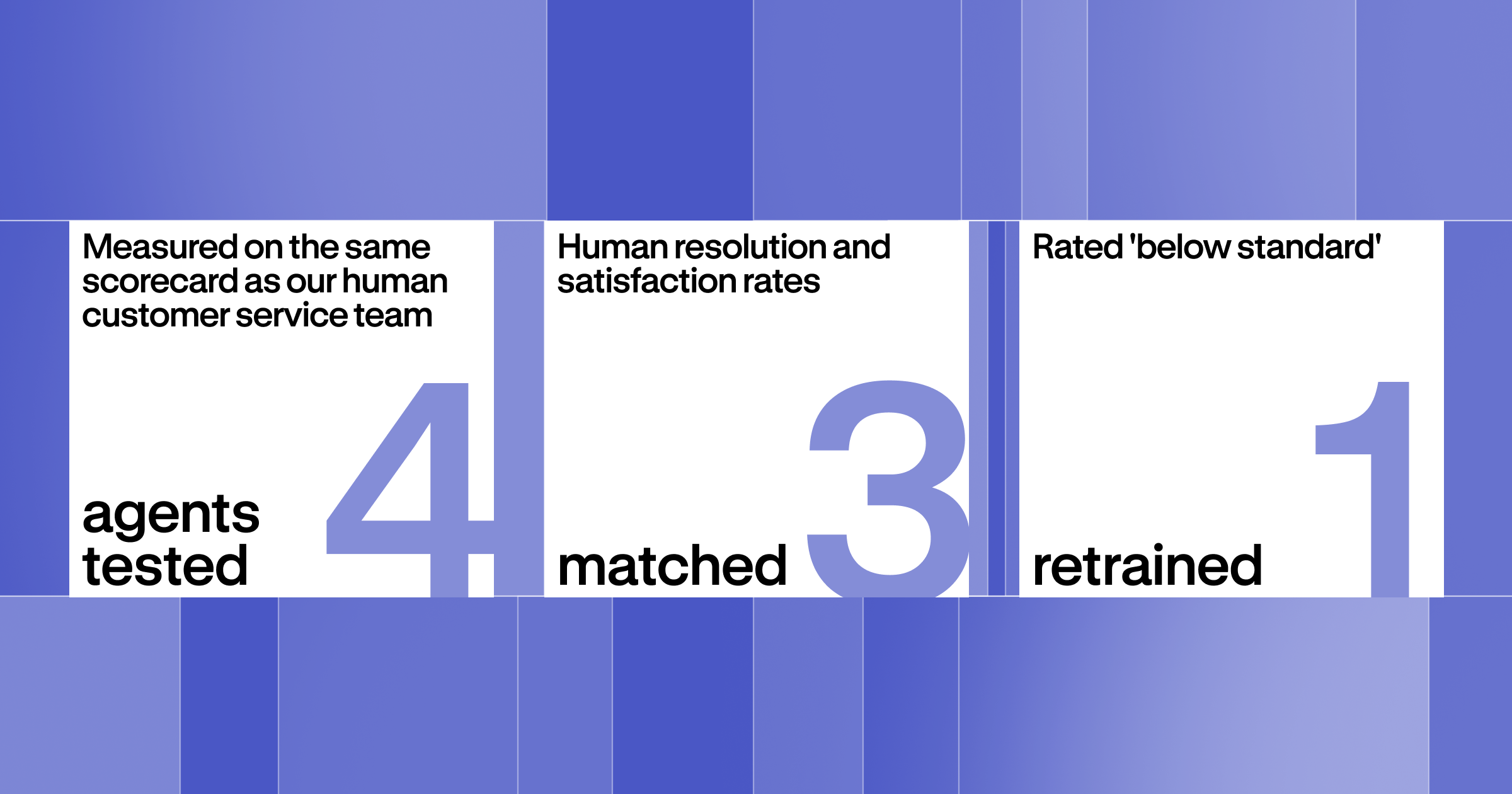
In customer service at Paysend we hold an AI agent to the same scorecard as a human colleague: how many contacts it takes on, how many it resolves completely, how a human reviewer rates its work, how often it needs to hand a case up the chain, and how satisfied the customer was with the resolution.
With this in mind, we used some third-party paid and open-source models, ‘trained’ on our own internal product and policy documentation, and competed them against each other. Because we’d agreed the metrics up front, measuring success after a few weeks of running the experiment was trivial.
Three of our four agents were able to resolve customer questions with the same resolution rate and satisfaction rate as a human agent, at one third of the cost. The fourth was equivalent to a human agent with our ‘below standard’ performance rating, causing us to remove and retrain the agent.
Specifying the exact success criteria for each experiment is what gives you the most confidence in the business impact of the work, creates the biggest ‘feel good' factor in the team, and translates into measurable performance in the company results.
Rule 3: Enable your best talent first, and build a library of what works.
As a leader, you have your ‘go-to’ people - those who take ownership of problems end to end; who deliver the business results consistently; and who work with high motivation and speed.
These are the people to empower with AI first. They will take the business challenges you have defined and try to solve them with huge enthusiasm, and will report back reliably on progress, whether they succeed or not.
Then it’s important to codify what works. The goal is a documented library of what was tried, what worked, how to maximise its impact across the company, and how to pivot on what doesn’t. With this, it’s far easier to scale the use of AI, iterating and expanding on what does work, rather than everyone trying from scratch.
How we document AI impact
We don’t track individual productivity gains from AI, because that measurement is too subjective. What we do document is impact that spreads. When someone’s AI initiative can be rolled out to their peers or to other teams, we document it, roll it out and measure the impact formally.
The resulting list of proven initiatives is a great source of ideas for people wanting to try out AI improvements, and of structured data for internal agents to identify new opportunities for improving the business.
One example is within our treasury department.
Our treasury lead, a recognized high performer, began using Claude to build queries and scripts to better forecast partner payment volumes and prefunding needs, run inside Databricks.
This resulted in better optimization of cash usage, and the capability was then rolled out across the entire treasury team, to facilitate speed of operation. With the use case formally documented, we see how it fits into the broader workflow at Paysend, with an eye towards how we can make it more automated, integrated and powerful.
Rule 4: Hire bar-raising talent into an AI-enabled environment.
With clear goals, impact, talent and process in place, you now have a great environment for adding new bar-raising talent to the team.
It’s possible to do this in parallel, but in my experience, hiring people into an uncertain environment and expecting them to revolutionise how a new group of people work is unrealistic.
It’s much better as CEO to take responsibility for the AI-enablement culture yourself and then hire people with proven individual impact into this environment to challenge and push the rest of your team.
Ben Chisell, Group CEO, Paysend
To find those people, we don’t simply ask candidates whether they’ve used AI. Instead, AI questions run through every stage of our hiring process, tailored to the role and designation, and they get deeper and more specific with each round.
The questions follow our career framework, because AI should do something different at each designation. For executives, it should expand the scope they can responsibly oversee. For objective owners, it should increase business impact. For initiative owners, it should multiply productivity. And for operational owners, it should automate routine work, freeing up capacity to take on more ownership.
Traditional frameworks tend to reward effort and output volume, which no longer fits when someone uses AI to deliver in a week what used to take a month. We’re shifting towards recognising the outcome and the judgement behind it: which problem someone chose to solve, how they solved it, whether it worked, and whether others can reuse it. Empowering your best people, and hiring proven talent, only works if your framework rewards that kind of impact.
Rule 5: Talk to other leaders who are really pushing their companies on AI adoption; don’t just watch YouTube.
Once you have an approach you feel has substance, it’s good to test it with other leaders who have practical experience driving the AI agenda at their companies. I suspect you’ll be pleasantly surprised that the structured approach above is more than most are doing, even those claiming full AI-maxing on the outside.
This is the first article in our series on how Paysend approaches AI. Tune in for part two.

 5 min
How to evaluate a global payouts API: the criteria that matter for international payouts
Choosing a payouts API is a strategic decision. We've identified the six criteria it comes down to: corridor coverage and delivery rails, payout speed, regulatory coverage, liquidity and FX efficiency, integration effort, and how much control you keep over the user experience.
 2 min
Paysend named to Sifted's 100 standout consumer businesses
London, 8th July 2026 — Paysend has been named to Sifted's list of the top 100 consumer businesses, recognising the companies behind the products people rely on every day.Paysend began nine years ago as a consumer app for cross-border money movement, built customer-first. Today it operates global payments infrastructure — the world's network of 25B+ endpoints across 170+ countries, with proprietary processing, FX, orchestration and settlement, proven at scale with billions of